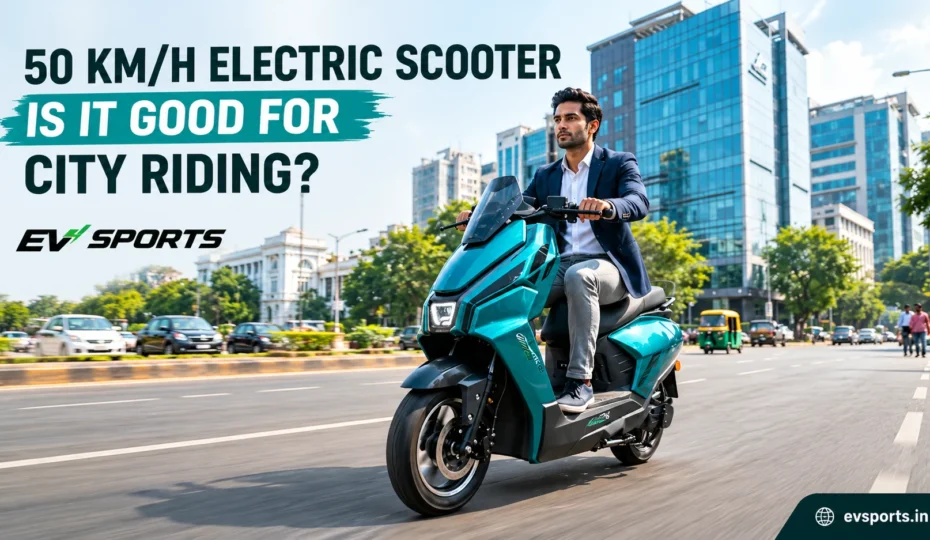
If you travel around the city every day, you probably don’t need a scooter that is built only for high speed. What matters more is whether the scooter is comfortable, reliable, easy to charge, affordable to run, and practical for your regular routes.
This is where a 50 km/h electric scooter can make sense.
With more people switching from petrol vehicles to electric two-wheelers, 50 km/h electric scooters are becoming an option for office commuters, students, business owners, and people who mainly travel within the city.
But is 50 km/h actually enough for everyday use?
Let’s take a closer look.
Is 50 km/h Enough for Daily City Travel?
For most normal city journeys, 50 km/h can be a practical speed.
Think about your usual commute. You may have traffic signals, busy roads, speed breakers, crowded market areas, and frequent stops. In these situations, riding at very high speeds isn’t always possible or necessary.
A scooter with a top speed of around 50 km/h can give you enough performance for regular city travel while still being easy to handle.
Of course, you should always follow the speed limits and traffic rules applicable to your location.
Why Are People Choosing Electric Scooters for Daily Commuting?
One of the biggest reasons is the cost of everyday travel.
With a petrol scooter, you need to keep buying fuel whenever the tank gets low. With an electric scooter, you charge the battery using electricity.
The actual running cost depends on the scooter’s battery, efficiency, electricity tariff, charging losses, riding conditions, and distance travelled. However, many riders consider electric scooters because charging can be more economical than regularly buying petrol.
If you travel to work or college every day, even small savings on your daily commute can add up over a month.
A 50 km/h Electric Scooter Can Be Useful for Different Types of Riders
A 50 km/h electric scooter isn’t only for office commuters.
It can also be useful for:
- College students travelling around the city
- People visiting markets and local shops
- Small business owners
- Daily commuters
- People travelling to nearby railway stations
- Riders who regularly make short city trips
- Families looking for an additional vehicle for local travel
If most of your journeys are within the city, you may not need a very high-speed scooter.
What About Electric Scooter Range?
Speed is only one part of the buying decision. Range is equally important.
The range mentioned by a manufacturer may not always be the same as what you experience on the road. Your actual range can change depending on several things.
For example:
- How fast you ride
- Rider and passenger weight
- Traffic conditions
- Road quality
- Number of stops and starts
- Tyre pressure
- Weather
- Riding mode
- Battery condition
So, instead of choosing a scooter only because it has a high claimed range, think about how far you actually travel every day.
If your daily commute is around 20–30 km, choose a scooter that gives you enough practical range to complete the trip comfortably without constantly worrying about charging.
Charging: Is It Difficult?
For someone new to electric vehicles, charging can seem like a major change from using a petrol scooter.
But if you have a charging point at home, it can become part of your normal routine.
For example, you can plug in the scooter after returning home and charge it according to the manufacturer’s recommended charging procedure.
Before buying an electric scooter, make sure you understand:
- Charging time
- Charger requirements
- Battery capacity
- Charging location
- Manufacturer’s charging instructions
- Battery warranty
This is especially important if you travel long distances every day.
What Should You Look for in a 50 km/h Electric Scooter?
Don’t choose an electric scooter based on speed alone.
There are several other things that can make a big difference to your daily riding experience.
1. Battery
The battery is one of the most important parts of an electric scooter.
Check the battery type, capacity, warranty, charging requirements, and availability of replacement support.
2. Motor
The motor affects acceleration and overall performance.
If you regularly ride with a passenger or travel on roads with slopes, look at the motor specifications instead of focusing only on the top speed.
3. Brakes
Good brakes are essential when riding through busy city traffic.
Check the braking setup and make sure the scooter provides the level of braking performance you need.
4. Suspension
Anyone who rides regularly knows how uncomfortable potholes and speed breakers can be.
A good suspension system can make everyday travel much more comfortable.
5. Tyres
Tyres affect grip, stability and overall riding confidence.
Make sure you check the tyre size and type before buying.
6. Comfort
If you’re going to ride the scooter every day, comfort matters.
Look at the seat, riding position, footboard space, handlebar position and suspension.
A scooter may look great on paper, but if it isn’t comfortable for your daily route, you may not enjoy using it.
7. Service and Spare Parts
This is something buyers sometimes overlook.
Before purchasing an electric scooter, check whether service support and spare parts are available in your area.
Good after-sales support can make ownership much easier in the long run.
50 km/h Electric Scooter vs Petrol Scooter
Both electric and petrol scooters have their own advantages.
An electric scooter runs on a rechargeable battery and doesn’t require petrol. It also has an electric motor instead of a conventional petrol engine.
A petrol scooter, on the other hand, can be refuelled quickly and doesn’t require access to a charging point.
Here’s a simple comparison:
| Feature | 50 km/h Electric Scooter | Petrol Scooter |
|---|---|---|
| Power source | Rechargeable battery | Petrol |
| Refuelling | Charging required | Petrol required |
| Engine | Electric motor | Petrol engine |
| Noise | Generally quieter | Engine sound |
| Regular maintenance | Fewer engine-related components | More engine-related components |
| City commuting | Suitable for many city routes | Suitable for city travel |
| Charging | Required | Not required |
The right choice depends on your travel habits, budget, charging access and personal requirements.
EV Sports Electric Scooters for City Riders
EV Sports offers electric scooter models designed for different everyday riding requirements.
Models such as GLIDE, ZIPSTER and DYNA are options for riders looking for electric scooters with speeds of up to 50 km/h, depending on the model and configuration.
If you’re considering an EV Sports scooter, look at the individual model specifications and compare factors such as battery, range, motor, braking, features, warranty and service support.
You can explore the available models and their specifications on the EV Sports website.
Is a 50 km/h Electric Scooter Good for You?
The answer really depends on how you use your scooter.
If your everyday travel mainly consists of city roads, office commutes, college trips, shopping, or short-distance travel, a 50 km/h electric scooter can provide a useful balance of speed and practicality.
But if you regularly travel long distances or need to use high-speed roads, you should look beyond the top-speed figure and check whether the scooter’s range, charging options and overall specifications match your requirements.
Simple Tips to Get Better Range
Once you buy an electric scooter, a few simple habits can help you get more consistent performance.
Keep your tyres properly inflated.
Incorrect tyre pressure can affect efficiency and handling.
Avoid unnecessary hard acceleration.
Smooth riding can help reduce unnecessary battery consumption.
Follow the recommended charging procedure.
Use the manufacturer’s recommended charger and follow the battery-care instructions.
Don’t overload the scooter.
Carrying more weight than recommended can affect performance and range.
Keep up with regular maintenance.
Check the brakes, tyres, lights and other important components regularly.
Final Word
A 50 km/h electric scooter can be a practical choice for everyday city travel.
You get enough speed for many common urban journeys, while the electric drivetrain can offer a quieter riding experience and potentially lower day-to-day running costs compared with a petrol vehicle.
However, don’t buy a scooter simply because it has a particular top speed.
Look at the complete picture — battery, real-world range, charging time, motor performance, brakes, suspension, comfort, warranty and after-sales service.
The best electric scooter is the one that fits your actual daily travel needs.
If you’re looking for an electric scooter for city commuting, explore the range of models from EV Sports and compare the specifications before making your decision.
Frequently Asked Questions
1. Is a 50 km/h electric scooter good for daily commuting?
Yes. For many city riders, 50 km/h can be sufficient for regular office, college, shopping and local travel. Your actual requirement will depend on your route and local traffic conditions.
2. How much does it cost to charge an electric scooter?
It depends on the battery capacity, electricity tariff, charging losses and how much charge the battery requires. Your actual cost can be calculated by checking the electricity consumed during charging.
3. What affects electric scooter range?
Speed, rider weight, traffic, road conditions, tyre pressure, weather, riding mode and battery condition can all affect the actual range.
4. What should I check before buying a 50 km/h electric scooter?
Check the battery, motor, practical range, charging time, brakes, suspension, tyres, warranty, service availability and spare-parts support.
5. Can a 50 km/h electric scooter be used for long-distance travel?
It depends on the scooter’s range, charging availability and the type of roads you travel on. For longer journeys, check the manufacturer’s specifications carefully before planning your trip.
6. Is an electric scooter cheaper to maintain?
Electric scooters generally have fewer engine-related components than petrol scooters, which can reduce some maintenance requirements. Actual maintenance costs depend on the model and how the vehicle is used.