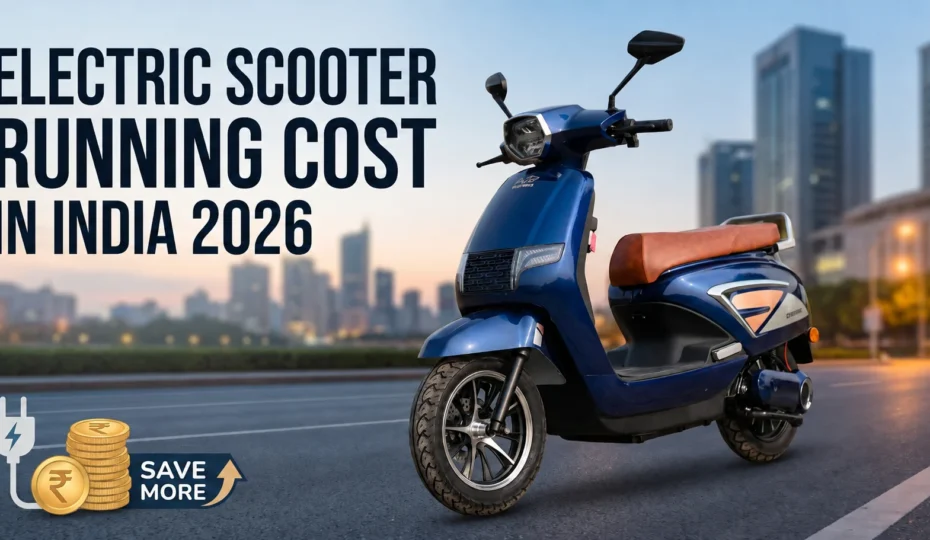
When people think about buying an electric scooter, the first thing they usually check is the price. But there is another important question that often gets overlooked: How much does it cost to run an electric scooter every day?
This is where electric scooters can make a big difference.
Instead of spending money on petrol every few days, you can charge an electric scooter at home and use it for your daily travel. For people who ride regularly, the difference in running expenses can add up to a good amount over a year.
So, is an electric scooter really cheaper to run than a petrol scooter? Let’s look at the numbers in a simple way.
What Is the Running Cost of an Electric Scooter in India?
The running cost of an electric scooter depends mainly on the battery capacity, electricity rate and the scooter’s actual efficiency.
For many electric scooters, the approximate home-charging cost can be around ₹0.20 to ₹0.40 per kilometre. However, the actual cost can vary depending on your electricity tariff, riding style, traffic and the scooter you use.
For example, if your scooter costs about ₹0.30 per kilometre to run and you travel 30 km in a day:
30 × ₹0.30 = ₹9 per day
So, a 30-km daily commute could cost only around ₹9 in electricity based on this example.
That’s one of the main reasons electric scooters are becoming popular among daily commuters.
How Much Does It Cost to Charge an Electric Scooter?
The charging cost depends on the size of the battery and the price you pay for electricity.
Let’s take a simple example.
Suppose your electric scooter has a 3 kWh battery and your electricity rate is ₹8 per unit.
The calculation would be:
3 kWh × ₹8 = ₹24
So, the basic electricity cost for a full charge would be around ₹24. In practice, the amount taken from the electricity supply can be slightly higher because some energy is lost during charging.
Your actual charging cost will depend on your scooter and local electricity rate.
Electric Scooter Cost Per Kilometre
One of the easiest ways to understand EV running costs is to calculate the cost per kilometre.
The basic formula is:
Running Cost Per Km = Electricity Used × Electricity Rate
For example, if an electric scooter uses around 0.04 kWh per kilometre and electricity costs ₹8 per unit:
0.04 × ₹8 = ₹0.32 per km
That means travelling 100 km would cost approximately:
100 × ₹0.32 = ₹32
Of course, this is only an example. Your actual electric scooter cost per kilometre may be different.
Electric Scooter vs Petrol Scooter: Which Is Cheaper to Run?
This is where the difference becomes easier to understand.
Let’s compare a typical example.
Electric Scooter
Assumed running cost: ₹0.30 per km
If you travel 30 km every day:
30 × ₹0.30 = ₹9 per day
For 26 days of travel:
₹9 × 26 = ₹234 per month
Petrol Scooter
Now suppose a petrol scooter gives a mileage of around 45 km per litre, while petrol costs approximately ₹105 per litre.
The petrol cost per kilometre would be:
₹105 ÷ 45 = ₹2.33 per km
For 30 km per day:
30 × ₹2.33 = ₹69.90 per day
For 26 days:
₹69.90 × 26 = approximately ₹1,817 per month
So, based on these assumptions:
Petrol scooter cost: ₹1,817/month
Electric scooter cost: ₹234/month
Potential monthly difference:
₹1,817 − ₹234 = ₹1,583
That could mean a difference of roughly ₹19,000 per year.
Keep in mind that this is an example based on assumed electricity and petrol prices. Your actual savings will depend on how much you travel, your scooter’s efficiency, petrol prices and your electricity tariff.
Electric Scooter Monthly Running Cost
Your monthly EV expense will naturally depend on how many kilometres you travel.
Here is a simple comparison using the same example figures:
| Monthly Distance | Electric Scooter | Petrol Scooter |
|---|---|---|
| 500 km | ₹150 | ₹1,165 |
| 800 km | ₹240 | ₹1,864 |
| 1,000 km | ₹300 | ₹2,330 |
| 1,500 km | ₹450 | ₹3,495 |
| 2,000 km | ₹600 | ₹4,660 |
These numbers are only for understanding the difference in energy/fuel costs. Actual costs can vary from one vehicle and location to another.
Does an Electric Scooter Cost Less to Maintain?
Running cost isn’t only about fuel or electricity. Maintenance also matters when you’re calculating the total cost of owning a vehicle.
Electric scooters have fewer mechanical parts compared with petrol scooters. They don’t have an engine that needs engine oil, and they don’t use spark plugs.
This can make regular maintenance simpler.
Depending on the model, you may still need to check:
- Tyres
- Brake pads
- Suspension
- Bearings
- Lights
- Electrical components
- Battery and charging system
An electric scooter is not completely maintenance-free. Regular servicing and proper battery care are still important if you want the vehicle to perform well over time.
How Much Can You Save on an Electric Scooter in One Year?
Let’s take the example of someone who travels around 1,000 km every month.
That means:
1,000 × 12 = 12,000 km per year
At an estimated EV running cost of ₹0.30 per kilometre:
12,000 × ₹0.30 = ₹3,600 per year
For a petrol scooter costing approximately ₹2.33 per kilometre:
12,000 × ₹2.33 = ₹27,960 per year
The difference would be:
₹27,960 − ₹3,600 = ₹24,360 per year
That’s a significant difference in daily running expenses.
However, remember that this calculation doesn’t include the vehicle’s purchase price, insurance, financing, servicing or possible battery replacement costs.
What Can Change Your Electric Scooter Running Cost?
The cost of running an electric scooter isn’t the same for everyone. Several things can affect your actual expense.
1. Electricity Price
Your electricity bill depends on your location and tariff. If your electricity rate is higher, your charging cost will also be higher.
2. Battery Size
A bigger battery usually needs more electricity to reach a full charge. On the other hand, it may also provide a longer range.
3. Your Riding Style
Fast acceleration and riding at high speeds can use more battery power. Smooth riding can help improve efficiency.
4. Traffic
Heavy traffic with frequent stopping and acceleration can affect energy consumption.
5. Tyre Pressure
Keeping the tyres at the recommended pressure can help the scooter run more efficiently.
6. Weather
Very high or low temperatures can influence battery performance and range.
7. Charging Losses
The electricity taken from your home supply isn’t exactly the same amount of energy that gets stored in the battery. Some energy is lost during the charging process, so this should be considered when calculating the actual cost.
Is an Electric Scooter a Good Choice for Daily Commuting?
For people who travel regularly around the city, an electric scooter can be a practical and economical option.
It can be especially useful for:
- Office commuters
- Students
- Delivery riders
- Local business owners
- Daily city travellers
- People who mostly travel short distances
The more kilometres you travel, the more important your running cost becomes.
However, don’t choose an electric scooter only because it is cheap to charge. Before buying, also check the real-world range, battery warranty, charging time, service network and overall vehicle quality.
Simple Ways to Reduce Your EV Running Cost
Want to get better efficiency from your electric scooter? A few simple habits can help.
Charge at home: If home charging is available, it can be a convenient and economical option.
Check tyre pressure regularly: Proper tyre pressure can help reduce unnecessary energy consumption.
Avoid unnecessary high speeds: Riding at very high speeds can drain the battery faster.
Use Eco mode when suitable: If your scooter has an Eco mode, it can be useful for normal city riding.
Look after the battery: Always follow the manufacturer’s charging and storage instructions.
Plan your charging: Charging overnight can be convenient for people who use their scooter every day.
Frequently Asked Questions
Is an electric scooter cheaper to run than a petrol scooter?
In most cases, yes. The electricity cost per kilometre can be much lower than the petrol cost, particularly when you charge the scooter at home.
What is the average electric scooter running cost per km?
For many home-charged electric scooters, the running cost can be roughly ₹0.20–₹0.40 per km. The actual cost depends on the scooter, electricity price and riding conditions.
How much does it cost to fully charge an electric scooter?
There is no single fixed amount because battery sizes and electricity tariffs are different. A small electric scooter may cost less to charge than a scooter with a larger battery.
Is an electric scooter suitable for daily office travel?
Yes. If your daily travel distance is within the scooter’s practical range and you have easy access to charging, an electric scooter can be a convenient option for office commuting.
Does an electric scooter need maintenance?
Yes. Although EVs have fewer mechanical components, they still need regular checks for tyres, brakes, suspension, electrical components and the battery system.
How much can I save by switching from petrol to electric?
Your savings depend on your monthly kilometres, petrol price, electricity tariff and vehicle efficiency. People who travel long distances every month can potentially save more.
Final Thoughts
The electric scooter running cost in India is one of the biggest reasons many people are considering an EV for their daily travel.
You may pay more or less depending on the model you choose, but the cost of electricity can be significantly lower than buying petrol regularly. If you ride every day, these small savings can add up over months and years.
Before buying an electric scooter, don’t look only at the showroom price. Check the battery warranty, real-world range, charging time, service support, maintenance requirements and overall ownership cost.
If you travel regularly and have convenient access to charging, an electric scooter can be a smart way to reduce your everyday transportation expenses.